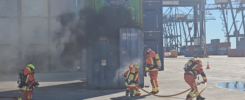
From 2 to 6 March, 2026 the IMAT (Italian Maritime Academy Technologies) Centre is hosting an important testing and validation phase for the Polish and Italian use cases developed within the OVERHEAT project. The activities bring together project partners to evaluate the performance of innovative solutions designed to improve the detection and management of fires on containerships.
During these days, simulations and practical tests are being carried out using IMAT’s advanced maritime training facilities. The objective is to assess how different technologies—such as sensors, drones and digital monitoring tools—can support early detection, improve situational awareness and assist crews and authorities in managing emergency situations at sea and near ports.
Polish Use Case
The Polish use case focuses on supporting port authorities in monitoring ship traffic approaching the port and identifying potential fire risks before vessels enter the harbour area. In this scenario, an Unmanned Aerial System (UAS) is used to inspect vessels waiting for clearance to enter the port.
If a thermal anomaly is detected in a container on deck, the drone immediately sends an alert to the port authority, allowing early communication with the ship and the activation of emergency procedures. The aim is to prevent cascade effects that could disrupt port operations and create risks for other vessels and port infrastructure. IMAT’s advanced maritime platforms provided data related to the ship’s behaviour in different sea conditions. Several scenarios have been tested to collect all the possible cases (ranging from a nominal harbour approach to a contingency event). This data are used from ILOT in their premises to identify the efficiency/effectiveness of the use of UAS to identify potential fire risks before vessels enter the harbour area.
Italian Use Case
The Italian use case focuses on detecting and managing containership fires directly on board the vessel. The scenario combines IoT sensors installed on containers and on the ship with the use of a drone to verify alarms and provide an aerial view of the situation.
When a sensor detects a potential fire, the drone is deployed to confirm the alarm, identify possible thermal anomalies and check whether crew members may be in danger on deck. This collaborative system allows crews to react quickly and improves the information available to firefighting teams, contributing to safer and more effective emergency response.
The tests currently underway at IMAT represent an important step in validating these solutions under realistic operational conditions.
Further details and results from the testing campaign will be shared in the next issue of the newsletter.